How rentosertib is thought to work
Rentosertib blocks a kinase called TNIK. Here is what that means, what the laboratory studies showed, and what is still unknown.
Rentosertib is designed to block one enzyme in the cell, a kinase called TNIK. The idea is that TNIK sits above several of the signalling systems that drive lung scarring, so switching it off might slow all of them at once. That idea has been tested in cells and in animals; in people it is still being tested.
What TNIK is, and why it is an unusual target
TNIK stands for TRAF2- and NCK-interacting kinase. A kinase is an enzyme that adds a chemical tag to other proteins, switching them on or off. Human cells contain more than 500 of them, and many medicines work by blocking one.
TNIK belongs to the STE20 superfamily of serine/threonine kinases, in a subgroup called GCK-IV alongside relatives such as MAP4K4 and MINK1. That is what makes it unusual as a fibrosis target: no antifibrotic medicine in use anywhere targets this kinase family. Nintedanib, one of the two medicines licensed for IPF in the UK, is a tyrosine kinase inhibitor, a different branch of the kinase family tree that hits a different set of proteins.
TNIK was already known to biologists for other reasons. It is an essential switch for Wnt target genes, and it has been linked to bowel, ovarian and thyroid cancers, to obesity and type 2 diabetes, and to tau biology in the brain. Until Insilico Medicine’s programme, nobody had developed it as a fibrosis target. By mid-2024 there were only about 150 papers on TNIK in PubMed.
The four signalling pathways
In the 2024 Nature Biotechnology paper, the authors set out a model in which TNIK sits upstream of four separate pathways that drive fibrosis. Think of them as four production lines in the cell, each ending in more scar tissue, with TNIK acting as a shared supervisor.
- WNT and beta-catenin. A developmental pathway that, reactivated in adult lung, pushes cells to multiply and lay down matrix.
- TGF-beta and SMAD2/3. The best-known scarring signal. It turns ordinary fibroblasts into myofibroblasts, the cells that produce collagen.
- TNF-alpha and NF-kappaB. An inflammatory pathway that keeps the tissue in a state of alarm.
- YAP and TAZ (the Hippo pathway). A mechanical sensor. Stiff tissue activates it, and activating it makes tissue stiffer still.
The authors argue that most antifibrotic drugs act on one of these lines at a time, whereas blocking TNIK might dampen all four. That is the hypothesis, not a demonstrated fact. The same paper reports that TNIK levels are higher in IPF lung tissue than in healthy lung, particularly in cytotoxic T cells, myofibroblasts and club cells.
What the laboratory evidence showed
The Nature Biotechnology authors report the following. All of it is laboratory or animal work.
In cells. Rentosertib reduced alpha-smooth muscle actin, a marker of myofibroblasts, in MRC-5 lung fibroblasts at low nanomolar concentrations. It blocked fibroblast-to-myofibroblast transition in fibroblasts taken from the lungs of people who had IPF. In bronchial epithelial cells from IPF donors it reduced fibronectin production at lower concentrations than nintedanib did in the same experiment.
On-target confirmation. When the researchers used shRNA, a technique that silences a single gene, to knock TNIK down directly, they saw the same effects as with the drug. That is the standard check that a compound is working through the protein it was designed to hit.
In mice. In the bleomycin model, a chemical injury that produces lung scarring, the authors report the fibrotic area reduced by more than 50% at 3 mg/kg twice daily and by more than 75% at 10 and 30 mg/kg twice daily, with a breathing measure comparable to nintedanib at 60 mg/kg. Combined with pirfenidone the effects were additive. In a separate acute lung injury model, the drug reduced the inflammatory signals IL-1 beta, IL-6, IL-7 and TNF-alpha.
In rats. An inhaled formulation reached lung concentrations roughly 50 times higher than those in the blood, and the authors report restored forced vital capacity (FVC), a measure of how much air can be breathed out, and improved lung compliance.
Beyond the lung. In a mouse model of kidney fibrosis, rentosertib reduced hydroxyproline and collagen I comparably to the reference compound SB525334. Applied to rat skin at 0.05% to 0.45%, it reduced collagen and hydroxyproline.
Animal models of IPF are weak predictors of human benefit. Many compounds that clear the bleomycin mouse model fail in people.
Detail for clinicians
Rentosertib is an ATP-competitive serine/threonine kinase inhibitor of the bis-imidazolecarboxamide chemotype. Reported potency and selectivity figures, from the 2024 Nature Biotechnology paper unless stated:
| Measure | Value |
|---|---|
| TNIK binding affinity, Kd by surface plasmon resonance (nM) | 4.32 |
| TNIK enzymatic inhibition, IC50 (nM) | 31 |
| Alpha-SMA inhibition, MRC-5 lung fibroblasts, IC50 (nM) | 27.14 |
| MRC-5 cytotoxicity, CC50 (µM) | 84.3 (about a 3,000-fold window) |
| Fibroblast-to-myofibroblast transition, IPF donor fibroblasts, IC50 (nM) | 50, 79, 63 |
| EMT (fibronectin), IPF bronchial epithelial cells (nM) | 250 to 400, versus nintedanib 1,600 to 7,900 |
| Alpha-SMA inhibition, HK-2 kidney cells, IC50 (µM) | 0.104 |
In a kinome-wide screen TNIK was the most inhibited kinase. The other sub-micromolar hits reported were ALK4, TGFBR1 and DDR1, each itself fibrosis-relevant, which cuts both ways: less of a toxicity liability than usual, but a confound when interpreting on-target effects.
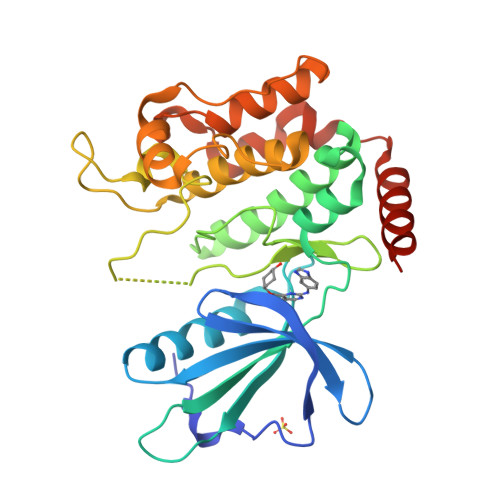
Binding mode. The described pose places the carboxamide oxygen as a hydrogen-bond acceptor to the Cys108 backbone NH in the hinge region, with the 4-fluorophenyl group extending past the Met105 gatekeeper into the hydrophobic back pocket. That back-pocket occupancy is the feature the authors present as differentiating rentosertib from earlier TNIK tool compounds such as NCB-0846.
Warning
No co-crystal structure of rentosertib bound to TNIK has been published. The binding mode above is a computationally predicted pose, modelled onto existing TNIK crystal structures solved with other ligands. It is a hypothesis about how the molecule sits in the pocket, not an observation.
An unverified claim. The chemical supplier MedChemExpress lists a TNIK/MAP4K4 dual inhibitor with potency of 12 to 120 nM. There is no primary source for dual MAP4K4 activity by rentosertib, and it does not appear in the peer-reviewed papers. MAP4K4 is a close relative of TNIK, so cross-reactivity would not be surprising, but it is not demonstrated in the published record.
What is not yet known
- Metabolism. The enzymes that break rentosertib down have not been published. CYP3A4 and CYP1A2 involvement is implied by the trial protocols, which ban grapefruit, but no metabolism study has been released. Protein binding, bioavailability and metabolites are likewise unpublished.
- Drug interactions. No interaction studies have been published. This matters because most trial participants also take nintedanib or pirfenidone.
- Toxicology detail. The company describes the drug as well tolerated in mice and dogs, but no numerical no-observed-adverse-effect levels are public.
- Long-term effects. The longest completed trial in people lasted 12 weeks. In that Phase 2a trial, 16 of 71 participants (22.5%) stopped early, and 7 of the 12 who stopped because of a side effect did so for liver injury or abnormal liver function. All recovered after stopping. The Phase III trial runs for 52 weeks, so nothing is known about longer use.
- Whether the mechanism matters. Even if rentosertib does block TNIK in human lung, it has not been shown that blocking TNIK changes the course of IPF.
Sources
- Ren F et al. A small-molecule TNIK inhibitor targets fibrosis in preclinical and clinical models. Nature Biotechnology 2024
- Ren F et al. 2024, open-access full text (PMC11738990)
- Medicinal chemistry of the INS018_055 series. Journal of Medicinal Chemistry 2024
- Xu Z et al. A generative AI-discovered TNIK inhibitor for idiopathic pulmonary fibrosis: a randomized phase 2a trial. Nature Medicine 2025;31:2602–2610
- TNIK as a therapeutic target: a review. Trends in Pharmacological Sciences 2024
- Masuda M et al. TNIK inhibitor NCB-0846. Nature Communications 2016
- Structural insight into TNIK inhibition (PMC9656744)
- RCSB Protein Data Bank entry 5D7A (TNIK kinase domain with NCB-0846)
- MedChemExpress product listing for a TNIK/MAP4K4 inhibitor (unverified secondary source)